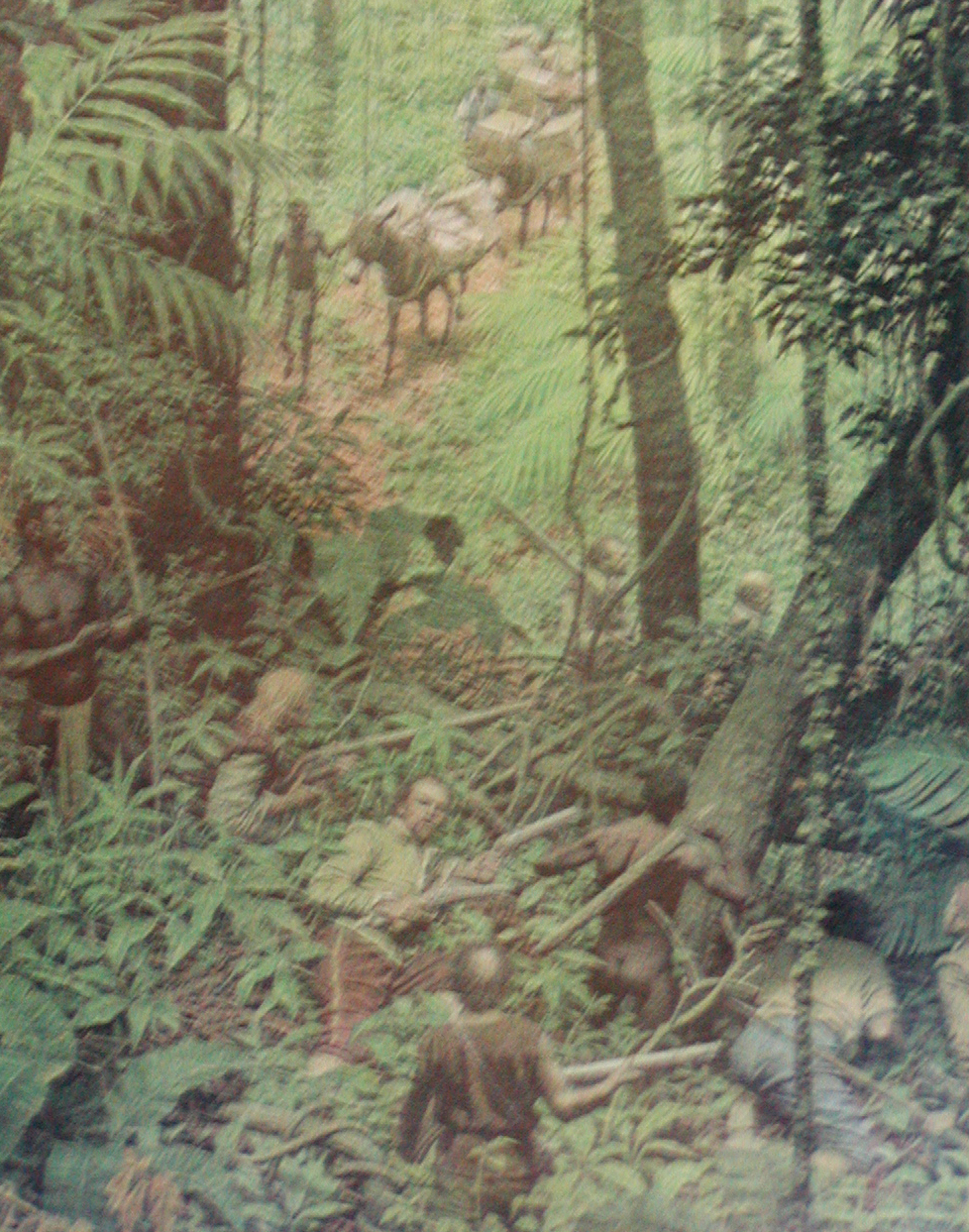
After 2 reconnaissance voyages to Panama in 1570 and 1571 to scout for suitable harbors and safe havens along the Panamanian coastline, Drake returned to the raid the Spanish mule trains carrying silver across the Panama Isthmus. Enlisting escaped African slaves (called Cimmarones) who hated their former Spanish owners, Drake used these strong warriors to gather intelligence on mule train shipments.
The Spanish mined silver in Peru and sailed the silver on galleons along the Pacific Coast to Panama. The silver was put on mules and transported to the Atlantic side of Panama for shipment to Spain.
At the suggestion of the Cimmarones, Drake climbs a tall tree and sees the Pacific Ocean. He vows to be the 1st Englishman to sail in the Pacific Ocean.
With the help of a French privateer named Guilleme Le Testu and his men, Drake and a group of 70 English, French and Cimmarones captured a huge silver laden mule train near the Atlantic port city of Nombre De Dios. There was so much silver, Drake and his men couldn’t carry all of it away and some was buried (later found by the reinforced Spanish forces)
Drake's expedition marched 2 days and got the silver back to ship and split it with the French. The Cimmarones got a their share but they were practical men and had no use for gold or silver. The Cimmarones wanted the ironwork from Drake's small, oar powered raiding boats (called pinnaces). Drake burned the pinnaces after getting the gold and silver on his ocean going ships and gave the ironwork to the Cimmarones. The Cimmarones used it to make crude instruments and weapons.
Drake and his crew parted ways with the French privateers and sailed home to England. As a show of triumph, Drake sailed past Cartagena, Venezuela (outside of the reach of Spanish fort cannons) with English flags waving from his ship's masts.
On Sunday August 9th 1573, Drake sailed in to Plymouth Harbor. The Plymouth population exited churches to witness Drake's return and the legend of the daring Francis Drake had begun.
SirFrancisDrakeHistory.Net-Page 1
Drake Sails Across Pacific Ocean and Returns to England-Page 4